The system,
in the order
the job runs.
Bid, buyout, build, bill. Thirteen desks, each one live today, each one carrying a rule about what it will not do. Nothing on this page is roadmap.
Pursuits
Before there is a job to estimate, there is an opportunity worth chasing, or one worth walking away from.
Bid opportunities submitted through your own website land here with the drawing set already attached, nobody retyping a submission by hand. Every inquiry is tracked until it is answered, priced, or closed, and a prequalification package assembles itself from what the system already knows about you, instead of getting rebuilt from scratch for the next RFQ.
Estimating
From the drawing set to a scope somebody can price.
Structured takeoff pulled from the drawings, carrying what each trade actually cost you on the last job. It assembles quantities, scope lines and the documents a bid must include.
Invitations to Bid
A subcontractor bids without an account, and their own words land on the sheet.
Invitations go out on your letterhead to your list. A subcontractor submits their number, their exclusions and their questions through a link, no login required. Their own language is read against your scope sheet and proposed as findings for your estimator to confirm or discard.
Buyout
The board that shows what you have actually bought.
Every trade as one of three states: bought, chosen but not awarded, or still an estimate. The middle column is the one nobody has: money you have committed to in conversation and never papered. Beside each sub, their paper track: insurance on file and how fast they sign on AsBuilt. Facts, never a score.
Purchasing
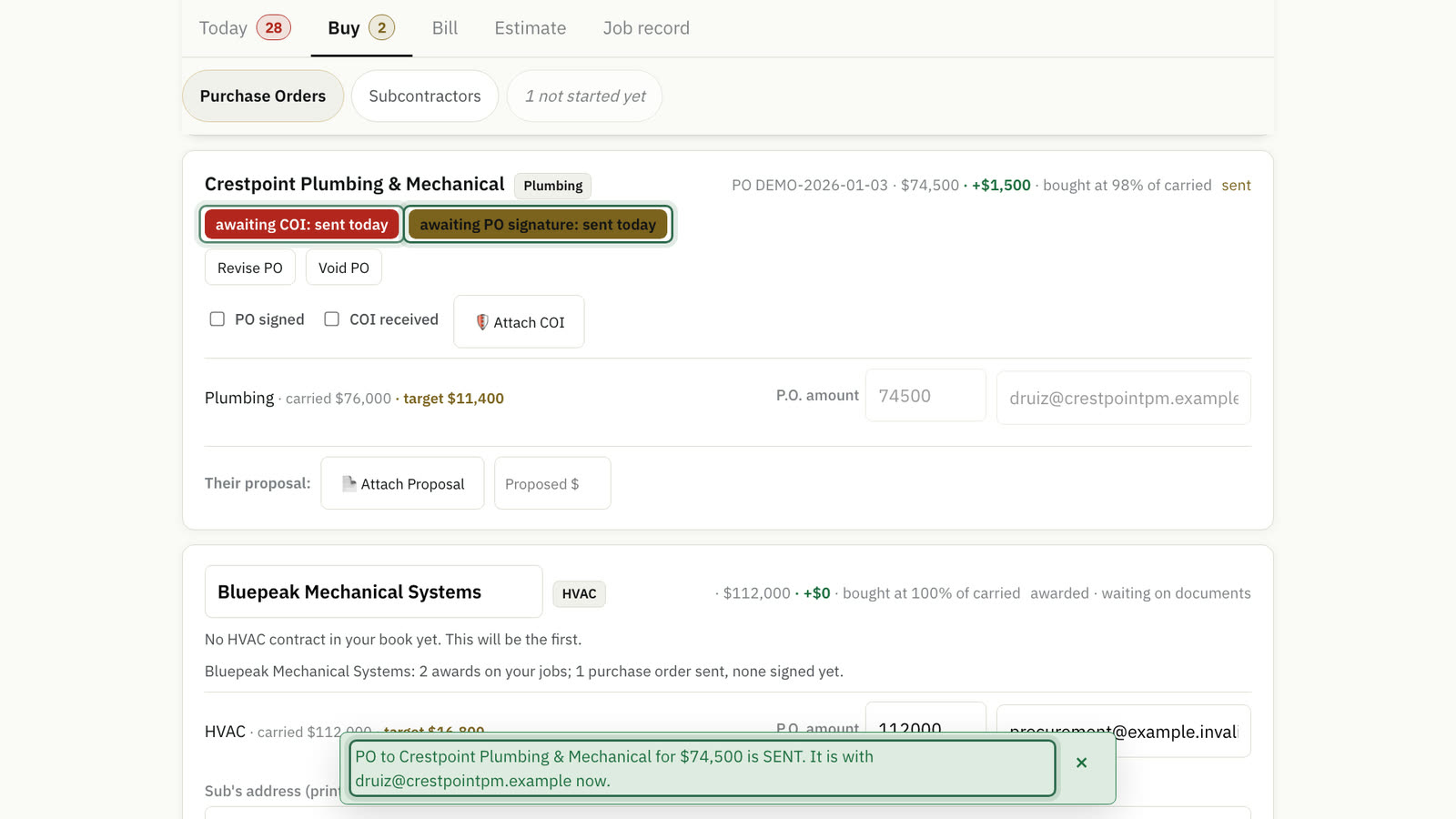
A purchase order your sub can sign without an account.
POs generate on your letterhead, send from your address, and are signed on a page at your web address. The packet (COI requirements, tax status, contacts, scope) assembles itself. Labor rates and sales tax can be marked not applicable, line by line, with a reason on record, never assumed. Nobody your sub deals with learns who built the software.
Change Orders
A price and scope change becomes a letter with its own number, not a conversation nobody wrote down.
Change orders price off the same schedule of values and markup rates as the original contract, whichever direction they run: to the owner, or to a sub. The letter goes out for e-signature, and only an executed one is allowed to move a contract sum, the same rule Billing holds.
Cost
What you owe your subs, and what they said it would cost, side by side.
Invoices are approved against retainage computed as arithmetic, never typed in by hand. A sub’s own original bid, filed against the purchase order the day it comes in, sits right next to their invoice when you are deciding on it, and if what has been billed runs past what they proposed, the line turns red with the exact dollar amount over.
Compliance
Certificates chased, filed, and read strictly.
COIs are requested, tracked against the purchase order they belong to, and filed automatically when they arrive. Expiries are watched, and a sub on the As-Built Record is reminded 30 and 7 days out and sends the renewal to you themselves. In New York, every deadline the system tracks carries the statute it comes from.
Submittals & RFIs
Your architect stamps through a link.
Transmittals assemble from the register and go out for review. The architect opens a link, marks up, and returns, no seat, no password, no procurement conversation. RFIs run the same door, with cost and time impact recorded as the answerer’s own claim. Meeting minutes go out the same way, one link, no account, for whoever needs the record. If your team runs RFIs and submittals through Procore today, this reads that data in every morning, on your own account, read only, and it retypes nothing.
Billing
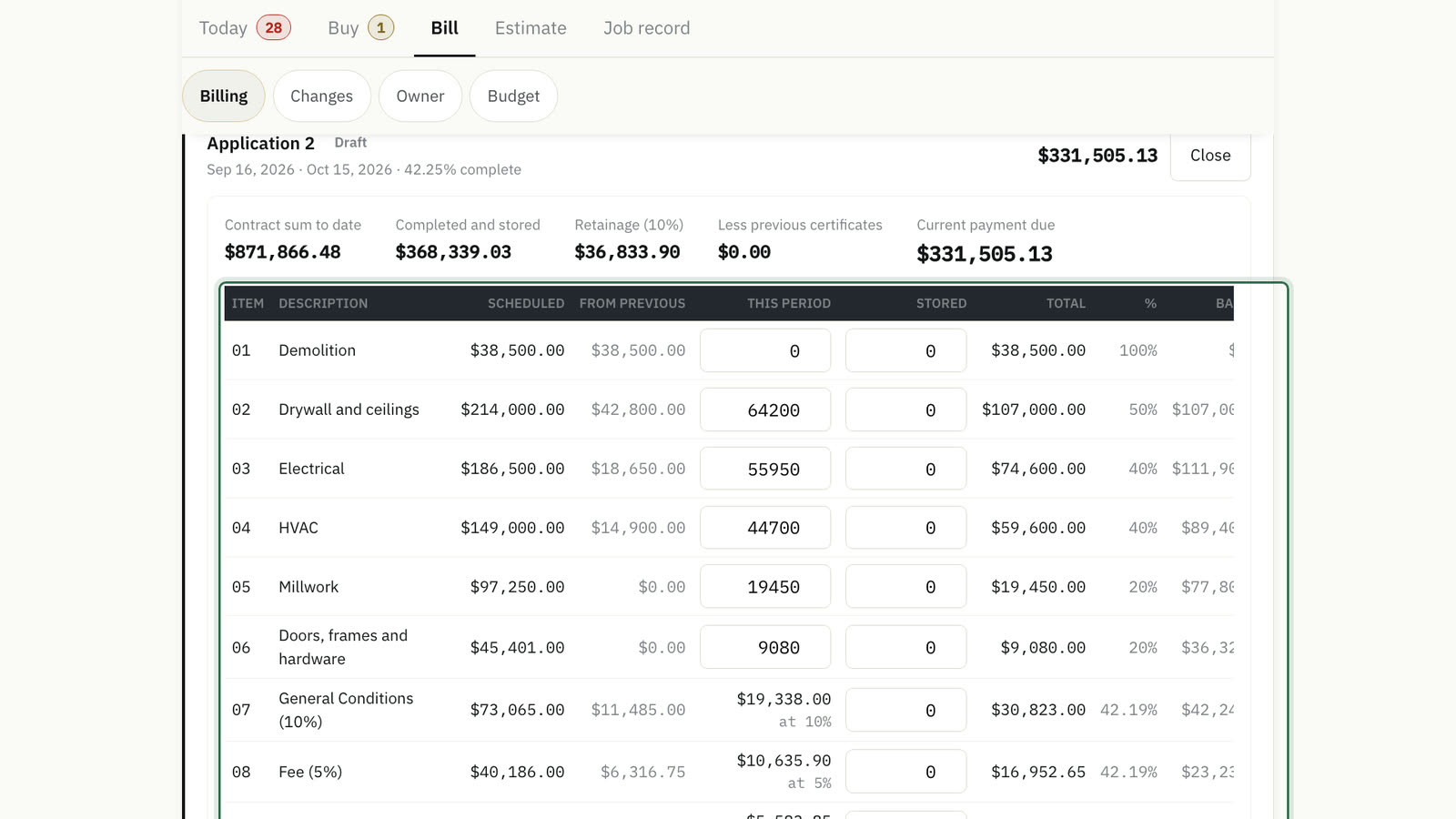
AIA G702 and G703, off the real schedule of values.
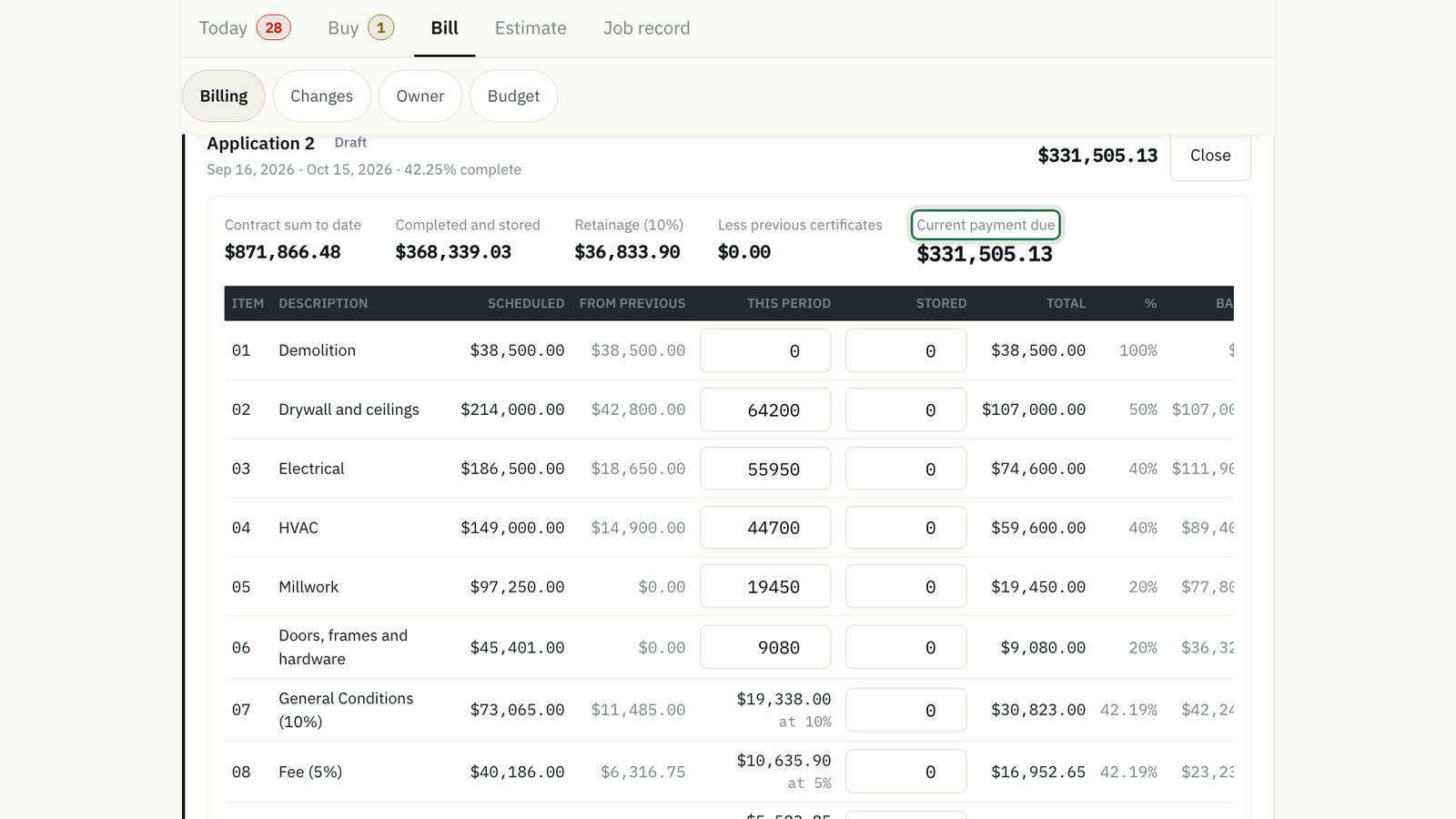
Applications for payment build from the schedule of values and the period’s actual completion, with retainage and previous certificates carried correctly. The continuation sheet is generated, not retyped.
WIP
Where the job actually stands financially.
Work-in-progress with over-billing and under-billing reported separately, forecasts that append rather than overwrite, and a contract sum that only moves on executed paper. The same numbers export to Sage, so the job cost report and the accounting system never quietly drift apart.
Field
Answers on a phone, one-handed, outdoors.
A superintendent looks up who owns a scope and gets the answer with its contract state attached. Drawings emailed to the office file themselves against the right job, nobody retyping a sheet index by hand. The daily log is append-only and works offline, syncing when the site gets signal.
Closeout
A punch item does not close itself, even when the sub says it is fixed.
Punch lists go out to subcontractors on the same no-login link as a purchase order. A sub marks their item done from their phone. That sends it back to you for review; it does not close the item. Closing it is your call, on your record.
And underneath all of it
It is yours, not ours.
Every desk above runs under your company’s name, on your domain, sending from your address, printing on your letterhead. Your subcontractors, your architect and your owner deal with you. The studio that built it appears nowhere on the documents and mail they get: not in a from-address, not on a purchase order, and, once your own address is connected (os.yourcompany.com), not in the URL they click. Two exceptions are yours to switch on: the free As-Built Record, offered to a sub only after they sign, and a maker’s credit in your website’s footer.
The data underneath is yours too, on a database that can be handed to you. That is the difference between a system you own and a seat you rent, and it is the whole reason this company exists.
If you run Procore
Keep it.
Nothing here asks you to leave Procore. Every morning AsBuilt reads your Procore RFIs and submittals into the record, on your own account. It writes nothing back. You keep what your team already knows, and you also get the record underneath it.
Why the record underneath matters: in 2025 Procore restricted bulk data downloads by its partners and cut off an outside AI vendor’s access to its API (source: ENR, October 2025). Your submittals, RFIs and daily logs are your company’s own evidence of its own work.